books


Books by Stephen Trombley


Forthcoming from Atlantic Books in 2011


VISIONARIES

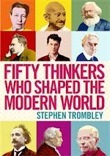
Fifty Thinkers Who Shaped the Modern World


Visionaries is an authoritative introduction to the ideas of the thinkers who have defined our world. It offers a crisp analysis of their key ideas, and in some cases a re-evaluation of their importance as we proceed into the twenty-first century.


At every turn, we find thinkers of the period harking back to their predecessors, laying the groundwork for those would follow. It is the presentation of these fascinating interconnections, in the context of historical and social movements, that makes Visionaries a fresh and original take on the history of western thought.


Forthcoming in 2011 from Atlantic Books

_________________________________________________________________


The Norton Dictionary of Modern Thought (ed. With Alan Bullock)


This single volume reference provides encyclopedic coverage of the key ideas that have shaped modern thought. More discursive than an ordinary dictionary, more compact than an encyclopedia, and more selective than either, it covers the whole range of modern thought from the latest developments in astrophysics to recent trends in the arts.


“How did one exist without this splendid book?” The Economist


“This is volume for which many of us are on many occasions going to be truly thankful.” Financial Times


“For more than 20 years this book has been a bible for those struggling to remember the meaning of everything from Marxism to the Mormons.” The Guardian


_________________________________________________________________


The Execution Protocol


This book does not concern itself with the debate over whether the death penalty is constitutional, correct or ethical. It reveals what happens when the state takes a life: what procedures are followed, what precautions are taken. When the courts impose a death sentence the condemned enters a shadowy and secret world that most people are happy to ignore. Author Stephen Trombley immersed himself in this world and was granted unprecedented access to the community of the condemned and their executioners. What emerges is a picture of men doing their jobs with a degree of purpose that is chilling. Dispassionate and thoroughly gripping, The Execution Protocol is a weird journey inside an America that few people ever see.


“It leaves the reader feeling uncomfortable, which is what a good book should do”. The

New York Times


“A grim, if compelling, journey into the world of America's legal death industry. Mr Trombley claims his purpose is to present the facts he observes in a detached manner, without passing judgment. What he produces, however, amounts to a forceful case against capital punishment.” The Economist


“Trombley's book is an account of the sanitisation of killing….It is a considerable tribute to his style that the facts seem to burst through the prose, leaving no trace of the author in my mind.” The Independent (London)

________________________________________________________________


The Right to Reproduce


This disturbing and wide-ranging work traces the origins of sterilization as a means of controlling people on the margins of society – not only criminals and the insane, but ordinary human beings, women in particular. Charting the rise of the eugenics movement in England, with its philosophy of encouraging the fit to breed while discouraging the ‘unfit’ through sterilization, Dr. Trombley documents the compulsory sterilization laws passed by American states, upon which the Nazi sterilization bill of 1933 was based. He also uncovers surprising support for sterilization from the Fabians in Britain and Progressives in the US, and traces sterilization as a social policy in the United States through the late twentieth century.


“thoroughly researched and well written…traces an inescapable road to ruin that begins with an initial thought and ends in outright genocide.” New Statesman


“Trombley is right to focus on the broad social and political issues which have made coercive sterilization such a feature of the twentieth century.” Social History of Medicine


“The standard text on the subject.” Paul A. Lombardo

________________________________________________________________


Sir Frederick Treves: The Extraodinary Edwardian


Sir Frederick Treves is most famous as the surgeon who treated the Elephant Man and saved King Edward VII’s life with an appendix operation. He was a pioneer of surgery, helping to transform it from a barbaric craft to a modern science. Through his service to three monarchs, he participated in the dazzling life of the court. As a man of adventure he volunteered his surgical skills during the Boer War, and returned to a controversy in which he spearheaded the reform of the Royal Army Medical Corps. He helped found the British Red Cross Society and worked for it during WWI. As a travel writer he explored remote corners of the world long before tourism. This is the only biography of a colorful Edwardian figure.


“Stephen  Trombley has served his subject well, producing a highly readable and consistently entertaining life which shows Treves ‘warts and everything’.” British Medical Journal


“There is much to savour in this biography.” Social History of Medicine

________________________________________________________________


Modern British Architecture since 1945 (ed. with Peter Murray)


A guide to the outstanding buildings of post-war Britain, chosen because they are important in the development of twentieth-century architecture, because they are fine examples of their type, or because they are the buildings everyone feels they must see. Almost 400 buildings

are described and illustrated in this guide, highlighting the wealth of good architecture since the War, and, particularly, the quality of building in the recent past.


________________________________________________________________


‘All That Summer She Was Mad’: Virgina Woolf, Female Victim of Male Medicine


This study examines the presuppositions behind Woolf’s doctors’ views on insanity. Trombley argues that the concept of her madness is not so much a medical diagnosis as an attempted theoretical justification for the enforcement of certain social, political, sexual, moral and esthetic assumptions.


“A very valuable and also a very readable book.” Quentin Bell in The Observer


“Trombley trenchantly spurns the sub-romantic bilge that it takes the savage god of madness to fire creative genius.” Roy Porter, New Society


“an important landmark in the survey of the development of psychiatry...his revelations are both startling and disturbing.” Review of English Studies


“Well-documented. Essential for all Virginia Woolf admirers.” The Bookseller


homehome.html


news


productionproduction.html


catalogcatalog.html


historyhistory.html


books


contactcontact.html


Worldview Pictures